The rule that covers most cases
Do not send money for a place that nobody you trust has seen.
That one rule stops the copied listing, the fake agent and the villa that does not exist. The scams that survive it are the ones where the villa is real and the person is not who they say. Those are covered further down.
We collect listings from public Facebook groups. We do not verify them, we do not meet the owners, and a listing on this site is not a recommendation.
Why Bali is an easy place for rental scams
- Rentals are posted in open Facebook groups, where anyone can post anything.
- People book from abroad, under time pressure, before they arrive.
- Yearly rent is paid in advance, so one payment can be thousands of dollars.
- Deals are made on WhatsApp, often without a contract.
- There is no public register a tenant can search in two minutes.
None of this means renting in Bali is dangerous. Thousands of people rent here every month without a problem. It means the checks are your job.
The common scams
The deposit to hold the place
The most common one. You find a villa, the person says several people are interested, and asks for a deposit today to hold it until you arrive. After the transfer, the account goes quiet.
The pressure is the tell. A real owner with a good villa knows it will rent, and is happy to show it.
The copied listing
Scammers copy photos and text from a real listing, an Airbnb page or a hotel site, and post them with their own number and a low price. The villa exists. They have nothing to do with it.
A reverse image search on two or three photos often finds the original, with a different contact or a different location.
The price that is too good
A two bedroom villa with a pool in Canggu for Rp 12M a month does not exist. The median asking rent for two bedrooms across our listings is Rp 30M, about $1,680.
Rp 32M
Median rent per month for 2 bedrooms in Canggu
Compare any listing with the median rent by area. A price at half the median needs a very good explanation, like a short gap in the calendar or a building site next door. A too-low price exists to make you hurry.
The fake owner
The less obvious case. The person renting the villa to you is a tenant, a former manager or a relative, and has no right to rent it out. You visit, the place is real, you pay a year in advance. The real owner appears a few months later and wants you out, or wants to be paid.
This is the scam that costs the most, because yearly rent is involved and the visit does not protect you.
The agent who is not one
Someone calling themselves an agent shows you a villa, takes a deposit or a “booking fee”, and vanishes. Or takes your year of rent and passes only part of it to the owner.
Real agents exist and do useful work. They have an office or a company, a history of posts, and they let you meet the owner before a large payment.
The deposit that never comes back
Not always a scam, sometimes just a bad landlord. At the end of the stay, the owner keeps the deposit for damage that was already there, or stops answering.
The switch
You agree on one villa and arrive to be told it has a problem, a leak or a double booking. A worse one is offered at the same price. Sometimes it is bad luck. Sometimes the first villa was the bait.
The surprise bills
The price was agreed, and then electricity, cleaning, a “banjar fee” or a “tax” appear on top. Asking what is included, in writing, before paying, removes most of this.
Warning signs
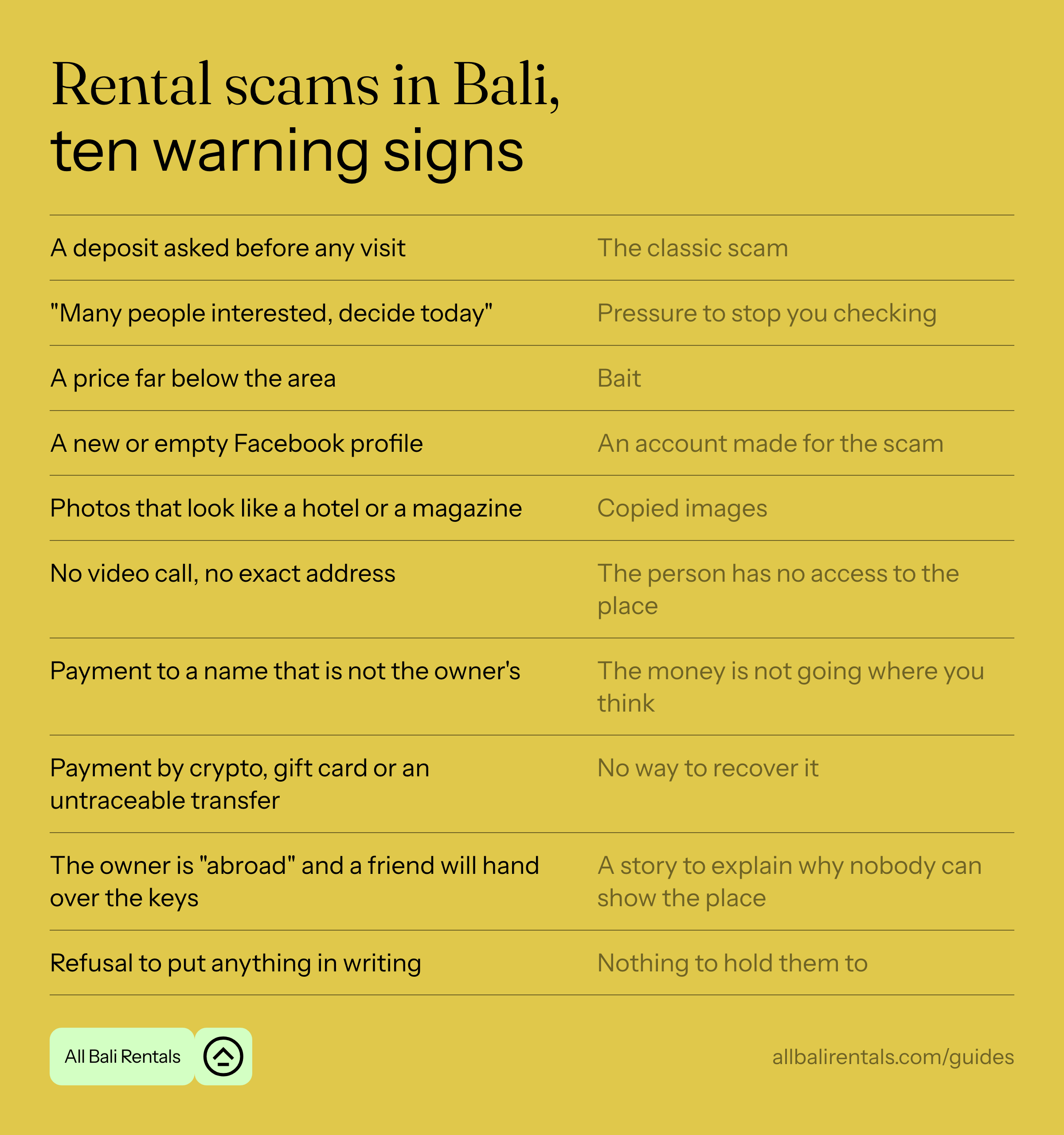
| Sign | What it usually means |
|---|---|
| A deposit asked before any visit | The classic scam |
| “Many people interested, decide today” | Pressure to stop you checking |
| A price far below the area | Bait |
| A new or empty Facebook profile | An account made for the scam |
| Photos that look like a hotel or a magazine | Copied images |
| No video call, no exact address | The person has no access to the place |
| Payment to a name that is not the owner’s | The money is not going where you think |
| Payment by crypto, gift card or an untraceable transfer | No way to recover it |
| The owner is “abroad” and a friend will hand over the keys | A story to explain why nobody can show the place |
| Refusal to put anything in writing | Nothing to hold them to |
One sign alone is not proof. A new profile can be a real owner who just joined the group. Two or three signs together are enough to walk away.
How to check a listing
- Search the photos. Run a reverse image search on two or three of them.
- Search the phone number on Google and inside the Facebook groups. Past complaints show up.
- Look at the profile. How old is the account, what has it posted, do the posts match one area and a real person?
- Ask for a video call from the villa. Someone with the keys can walk you through it live and show the street outside.
- Ask for the map pin and check it against the photos on street view or satellite.
- Compare the price with the rent prices index.
- Ask in the groups if anyone knows the place or the agent. People answer.
The same villa posted by several accounts is normal in Bali, since owners give their place to several agents. We merge those duplicates on this site. What is not normal is the same photos with different addresses.
How to check the owner
For a monthly rental, a visit and a receipt are usually enough.
For a yearly rental, do more.
- Ask to see the land certificate and the ID of the person named on it.
- If the person signing is not the one on the certificate, ask for written permission from the owner, and meet or call the owner.
- If you are subletting from a tenant, ask for their contract. It should allow subletting and run longer than your stay.
- Talk to the staff and the neighbours. They know who owns the place.
- For a contract of several years, pay a notary to verify the documents.
An honest owner expects these questions.
If you are booking from abroad
This is where most people get caught. The safer way:
- Book a few nights in a hotel or guesthouse through a platform that holds the payment.
- Shortlist monthly rentals and arrange visits for your first days.
- Pay nothing for the rental before you have seen it.
If you must secure a place before landing, ask a friend on the island to visit, or use a platform with payment protection for the first month and move to a direct deal after.
Before you pay
- You, or someone you trust, have visited.
- You know who the owner is.
- You have a written agreement with names, dates, price, deposit terms and what is included.
- You pay by bank transfer to the person named in the agreement, or in cash against a signed receipt.
- You have photos and a video of the place on move-in day.
The guide on how to rent in Bali goes through the contract and the deposit.
If you have been scammed
Act quickly, and keep expectations realistic.
- Call your bank or card provider at once. A transfer made minutes ago can sometimes be stopped, and card payments can be disputed.
- Save everything: the post, the profile, the messages, the payment proof, the phone and account numbers.
- Report the profile and the post to Facebook, and tell the group admins so the account is removed.
- File a report with the Indonesian police. Recovery is rare, and the report helps with your bank and your insurer.
- Warn others in the groups, with facts and screenshots.
Longer leases
Scams around leaseholds and villa investments involve bigger sums and other tricks, such as land that cannot be built on, leases sold by someone with no title, and projects that are never finished. If you are looking at a lease of several years, read leasehold vs freehold in Bali and hire a notary of your own.
If a listing here looks wrong
Tell us through the contact page with the link of the listing. We remove listings that are reported as fraudulent.