The two at a glance
| Freehold | Leasehold | |
|---|---|---|
| Indonesian name | Hak Milik | Hak Sewa |
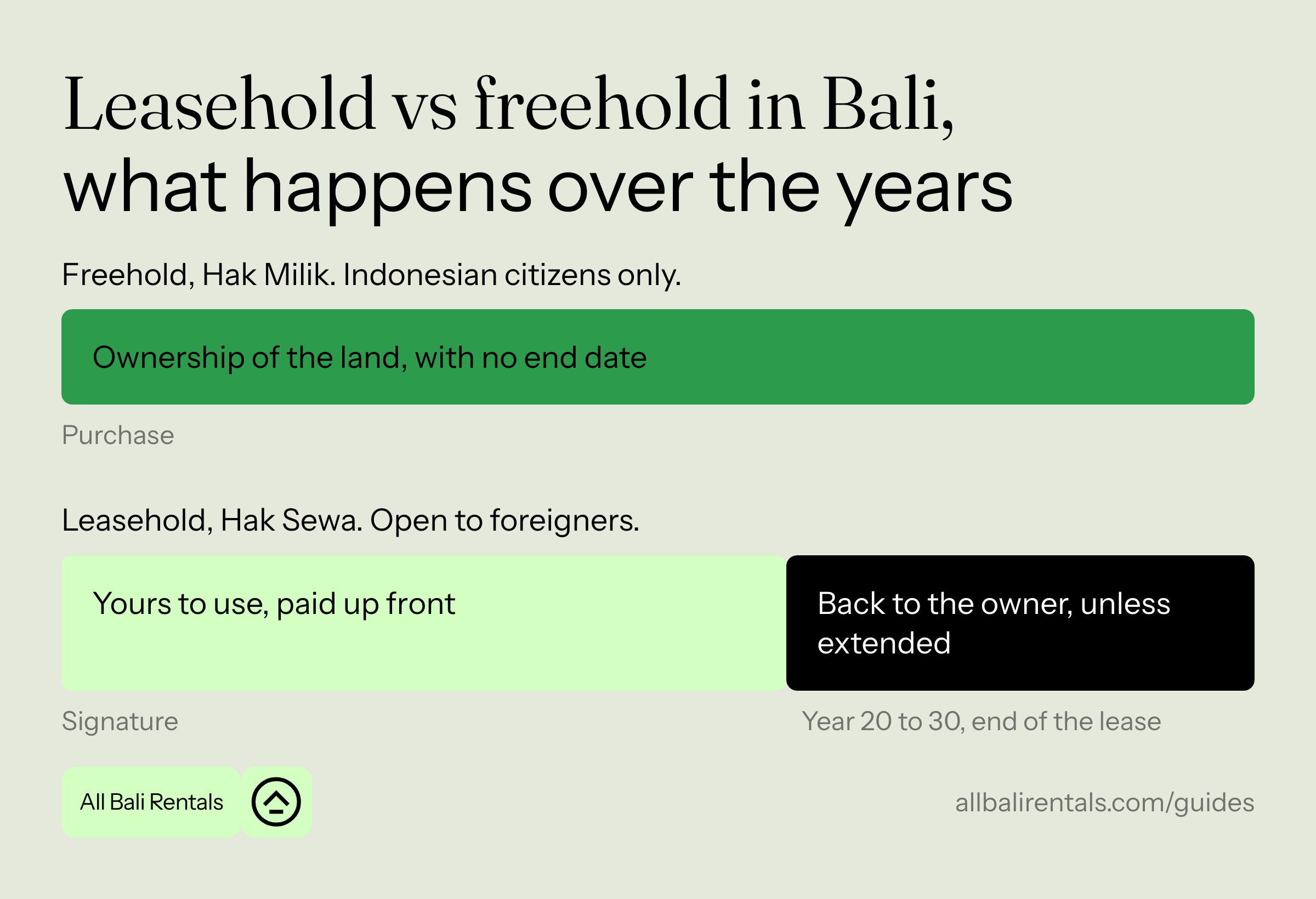
| What it is | Ownership of the land, with no end date | The right to use the property for a set period |
| Who can hold it | Indonesian citizens only | Anyone, foreigners included |
| Duration | Unlimited | Whatever the contract says, often 20 to 30 years |
| Payment | Purchase price | The whole lease up front, in most cases |
| At the end | Nothing changes | The property returns to the owner |
| Can be sold | Yes | The remaining years can be transferred, if the contract allows |
| Price | Highest | Lower, and falls as the years run out |
What freehold means in Bali
Freehold land, called Hak Milik, is the strongest title in Indonesian law. It has no time limit and passes to heirs. Only Indonesian individuals can hold it. A foreigner cannot, and neither can a foreign-owned company.
When a listing says “freehold”, it is aimed at Indonesian buyers, or at foreigners who plan to use one of the structures below.
The nominee arrangement
For years, foreigners bought freehold land in the name of an Indonesian citizen, the nominee, with side agreements meant to protect them, such as a loan, a power of attorney or a lease back.
On paper, the nominee owns the land. Indonesian law does not recognise the foreigner’s claim, and courts have treated these agreements as void. If the nominee dies, divorces, falls into debt or changes their mind, the foreigner can lose everything. The authorities have also been auditing these arrangements.
Many people did it and some still do. It remains the riskiest way to hold property in Bali, and no serious notary will tell you otherwise.
What leasehold means in Bali
A leasehold, called Hak Sewa, is a long rental. The landowner keeps the title. You get the right to use the land and the buildings for the period written in the contract.
You pay for the whole period at the start. Within the contract you can live in the property, renovate it, and often sublet it or rent it to guests. If the contract allows, you can sell the remaining years to someone else.
When the lease ends, everything on the land returns to the owner, the villa you built included, unless an extension was agreed.
A leasehold is a contract between two people. Its strength depends on what is written, and on whether it was signed before a notary and registered.
Other titles you will hear about
Right to use, Hak Pakai. A title that a foreigner with a stay permit can hold in their own name, for a house to live in. It is granted for a first period and can be extended and renewed, for up to 80 years in total under current rules. Minimum property values apply. It is a registered right, stronger than a private lease, and less common in Bali than leasehold.
Right to build, Hak Guna Bangunan. A title that a company can hold, including a foreign-owned company, called a PT PMA. This is the route for people who build and operate rental villas as a business. The company has capital requirements, accounting and tax obligations.
For someone who wants a home to live in, the practical choice is between a yearly rental, a leasehold, and sometimes a right to use.
How a leasehold is priced
The price of a leasehold is compared per year. Divide the total by the number of years left.
A two bedroom villa offered at Rp 2.5 billion for 25 years costs Rp 100M a year, before running costs. A yearly rental of a comparable villa is higher. The median for two bedrooms in our listings is Rp 225M a year, about $12,570.
So a leasehold is cheaper per year, and you pay 25 years at once.
What moves the price:
- Years remaining. A lease with 12 years left is worth much less than one with 28. Listings do not always make this obvious.
- Location. Land near the beach in Canggu, Pererenan or Uluwatu commands the highest lease rates.
- The building. Age, quality and whether it has the right permits.
- The extension clause. A lease with a fixed, pre-agreed extension price is worth more than one that says “to be negotiated”.
A leasehold loses value every year, like a car lease in slow motion. The exception has been rising land prices, which have lifted lease prices in the popular areas. Do not count on it.
See the current leasehold listings in Bali.
What to check before signing
Your notary does the legal checks. You should know what they are.
- The title. The land certificate must be in the name of the person who signs, and free of disputes, mortgages and inheritance claims. If the land belongs to a family, every heir who has a say should sign.
- The seller of an existing lease. If you buy the remaining years from another foreigner, read the original lease. Check that it allows a transfer and that the landowner consents in writing.
- The zoning. Each plot has a zone. Residential, tourism, agricultural and green zones do not allow the same things. A villa for short-term guests needs tourism zoning. Building on agricultural land is where many projects have been stopped.
- The building permit. The building should have its approval, called PBG, which replaced the older IMB. Ask for it, and for the certificate of worthiness if the villa will host guests.
- The years left. Count from the contract, not from the listing.
- The extension. Do you have the right to extend, for how long, and at what price or formula? “Priority to extend at market price” is weak.
- Subletting and resale. Whether you may rent the property out, and sell the remaining years without paying the owner a fee.
- Access. The road to the property must be public, or covered by a written right of way. Disputes over access lanes are common.
- Taxes. Lease income is taxed in the hands of the landowner, at 10 percent of the lease value. Contracts often pass this to the buyer. Find out who pays, along with the notary fee.
- What happens if the owner dies or sells. The lease should bind heirs and buyers. Registration helps here.
The costs on top
- Notary fees, usually around 1 percent of the transaction.
- The tax on the lease, if the contract puts it on you.
- Your own lawyer for due diligence.
- Running costs each year, including staff, pool, garden, repairs, electricity and banjar fees.
- Renovation. A tropical climate is hard on buildings, so budget for a roof and for repainting every few years.
Leasehold or a yearly rental
| Yearly rental | Leasehold | |
|---|---|---|
| Money committed | One year of rent | The whole lease, often 20 years or more |
| Cost per year | Higher | Lower |
| Freedom to leave | At the end of each year | You have to find a buyer for the remaining years |
| Freedom to renovate | Limited | Wide |
| Checks needed | Light | Full legal due diligence |
| Risk if something goes wrong | One year of rent | A large sum |
A leasehold makes sense when you have lived in Bali long enough to be sure of the area, you plan to stay many years or to rent the property out legally, and you can afford to tie up the money.
A long term rental makes sense in every other case, and for your first years here in any case. Many long-term residents rent year after year and never take a lease.
Can a foreigner own a house in Bali?
Not the land under it, in their own name. A foreigner can hold a lease on a house, hold a right to use title with a stay permit, or own a company that holds a right to build. Each gives real, time-limited rights. None is freehold.
Anyone who tells you that you can “own freehold” as a foreigner is describing a nominee arrangement, whatever they call it.
Visas
A lease does not give you the right to stay in Indonesia. You still need a visa or a stay permit. Some long permits, like the second home visa, can be based on property or a bank deposit. See the long stay visas for Bali.
Before you go further
Rent in the area for a year first. Visit the plot in the rainy season. Meet the neighbours. And read the rental scams guide, because the fake owner problem applies to leases with more zeros on the cheque.